


By: Dr. Shlomo Widder, M.D., Board-Certified Plastic Surgeon (American Board of Plastic Surgery)
Before any conversation about technique or recovery, there is a more basic question worth answering honestly: are you a good candidate for this procedure right now, or would you be better served by waiting, by a different procedure, or by addressing something else first? A good consultation answers that question directly, sometimes with an answer you were not expecting to hear.
What a Tummy Tuck Addresses
Abdominoplasty, commonly called a tummy tuck, removes excess abdominal skin and can tighten underlying abdominal muscles that have stretched or separated, most often after pregnancy, significant weight change, or aging. It is not a weight-loss procedure, and it is not designed to treat fat the way liposuction is, though the two are sometimes combined depending on what an individual case calls for. The American Society of Plastic Surgeons offers a general overview of the procedure.
Understanding what a tummy tuck is and is not built to fix often answers a good part of the “am I a candidate” question on its own.
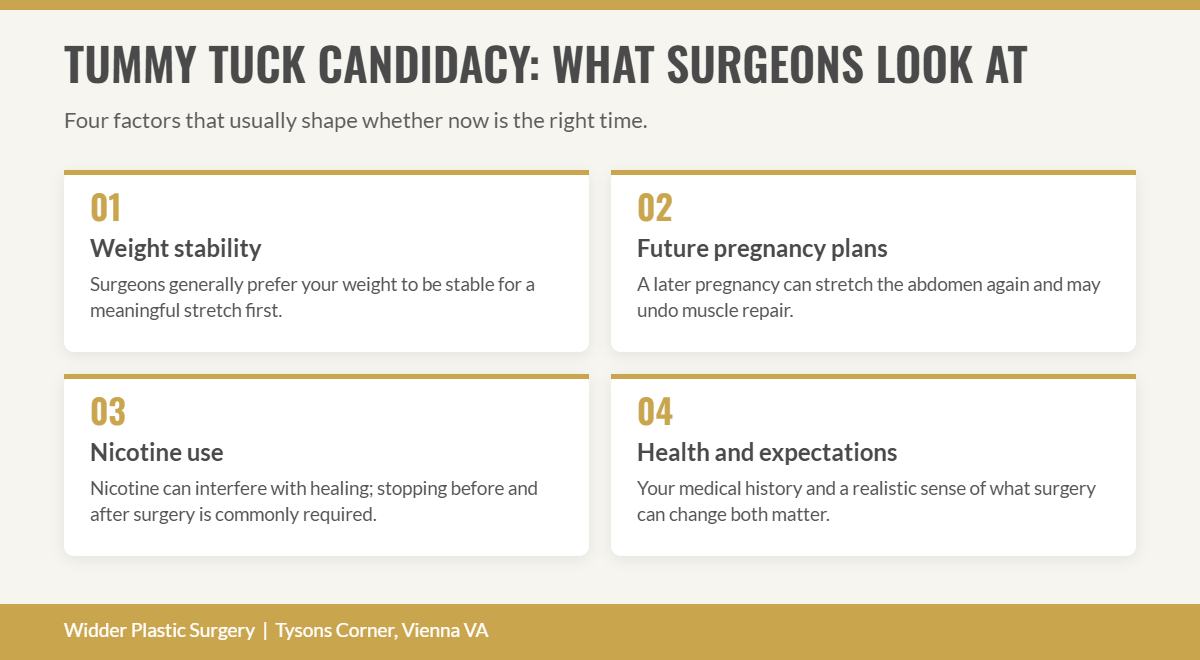
The Factors That Usually Matter
Weight stability
Significant weight change after surgery can affect results in ways that are hard to predict or correct. Surgeons generally prefer to see that your weight has been stable for a meaningful stretch of time before moving forward. If you are still actively losing weight, waiting until you have plateaued is often the more honest recommendation, even if it is not what you want to hear.
Plans for future pregnancy
A future pregnancy can stretch the abdomen again and may undo some of what surgery achieved, including any muscle repair. If you are planning future pregnancies, raise it openly, since it may change the timing recommendation.
Nicotine use
Smoking and other forms of nicotine can interfere with healing and raise the risk of complications. Surgeons commonly ask patients to stop nicotine for a period before and after surgery. This is a real safety consideration, not a formality.
Overall health and expectations
Some health conditions can affect candidacy or call for extra precautions, which is why your full medical history matters. Expectations matter as much as physical factors. A good candidate understands that this is a body-contouring operation with a real recovery, not a shortcut, and has a realistic sense of what it can and cannot change.
None of these factors are about whether someone “deserves” the procedure. They are about whether now is the time that offers the safest path toward the change a person is hoping for.
Reasons a Surgeon May Recommend Waiting
Being told “not right now” is not the same as being told “no.” Common reasons a surgeon might suggest waiting include:
- You are still losing weight or planning significant weight changes.
- You are planning a future pregnancy.
- You currently smoke, vape, or use other nicotine products.
- You have a health condition that needs to be addressed or stabilized first.
In many of these situations, the honest answer is a plan for what needs to change before you revisit the conversation, not a permanently closed door.
Questions Worth Asking at a Consultation
A consultation is where candidacy is evaluated for you specifically, not in general terms. It helps to arrive with your own questions:
- What would make me not a good candidate right now?
- Is there anything you would recommend I do before moving forward?
- What does recovery typically look like for someone with my health, my job, and my responsibilities at home?
- Who will perform my surgery, and is that the same person I am meeting today?
- What does a quoted price include?
The last question matters more than people expect. Costs vary with what a specific procedure involves, so ask for a clear breakdown up front to avoid surprises later.
What a Tummy Tuck Can and Cannot Promise
Results vary with individual anatomy, the technique used, and how your body heals, and no surgeon can promise a specific outcome. What a good consultation can offer is an honest assessment of what is realistic for your situation, including scarring, which is a lasting part of this procedure and worth discussing directly rather than glossing over. If you look at before-and-after photos as part of your research, remember that they show individual patients and are not a prediction of your own result.
Considering a Tummy Tuck in Tysons Corner or Northern Virginia
Widder Plastic Surgery is located at 8230 Leesburg Pike, Suite 630, in Vienna, in the Tysons Corner area of Fairfax County, convenient to patients from McLean, Great Falls, Falls Church, Arlington, and Reston. Dr. Shlomo Widder is a plastic surgeon certified by the American Board of Plastic Surgery.
Wondering whether you are a good candidate right now? Schedule a consultation for a direct answer, even if that answer is “not yet.”
Frequently Asked Questions
How do I know if I’m a good candidate for a tummy tuck?
Weight stability, plans for future pregnancy, nicotine use, and overall health are the main factors. A consultation is where these are evaluated for your situation, since general guidelines only go so far.
Can I get a tummy tuck if I’m still trying to lose weight?
Surgeons generally recommend waiting until your weight has been stable for a meaningful period, since significant weight change after surgery can affect the result. If you are still actively losing weight, discuss timing at a consultation.
Will a tummy tuck help me lose weight?
No. It is a body-contouring procedure that removes excess skin and can tighten abdominal muscles. It is not a weight-loss method, though it is sometimes combined with liposuction depending on the individual case.
Can I have children after a tummy tuck?
Pregnancy after a tummy tuck is possible, but it can stretch the abdomen again and may undo some of the surgical result. If a future pregnancy is a possibility, raise the timing question at your consultation.
What does a tummy tuck cost?
Cost depends on what your specific procedure involves. Ask what a quoted price includes at your consultation, since it varies from case to case and a clear answer up front helps avoid surprises.
Disclaimer: Individual results vary. This article is general information, not medical advice, and it does not replace an in-person evaluation by a qualified surgeon.